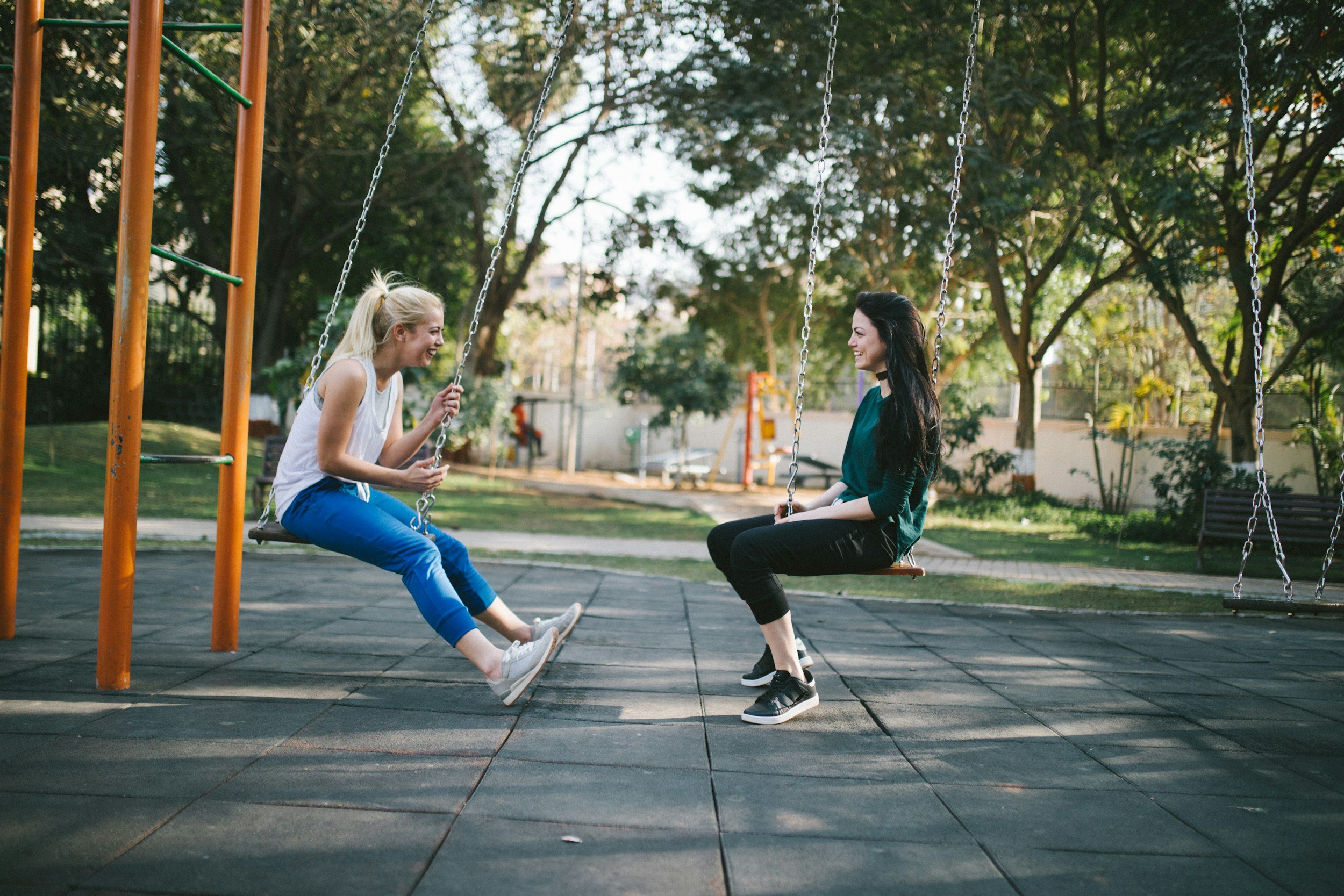
I met up with a good friend recently. We’ve known each other since university, where we shared rooms, so we have a lot of common ground - including the obligatory shared embarrassing memories! Our youthful misdemeanours have given us a special bond, although I sometimes wonder how on earth our landlord put up with us.
Biking in Boulder
Finding my voice
Finding safety again
When you live with chronic pain, ‘safety’ might not be the first word that comes to mind. You might be more familiar with tension, tightness and the constant background hum of worry, wondering when the next flare-up will come. But what if feeling safe enough was actually one of the keys to helping your body and brain heal?
Climbing and connecting
Many years ago, a dear friend of mine asked me to be godmother to her daughter Jess. I’ve loved following Jess’s development from infant to competent professional, but over the years there’s been little opportunity for us to catch up, for a variety of reasons. I often need a nudge to contact her outside of Christmas and birthdays.
Simon’s story
From Resistance to Release
We’ve all been there - that heavy, dragging feeling when we just don’t want to do something. It could be a workout, a difficult conversation, tidying the house or sitting down to a creative project. There’s a quiet tug inward, a little voice that whispers ‘not now… maybe later’. Resistance creeps in subtly, sometimes disguised as tiredness, distraction or apathy. If we’re not careful, it can pull us into full withdrawal, disconnected from what we intuitively know is good for us.
Chris’s story
When Chris* reached out to me he’d been experiencing chronic back pain for almost a year and low, grumbling pain for far longer. It was only when it had become unbearable that he contacted me.
A great sadness was how much his world had shrunk. He’d loved sport and playing Tag Rugby in particular, as well as enjoying the social life that accompanied it. Now none of this was possible because of the debilitating back pain.
Self-limiting beliefs
To heal or to cure: what’s the difference?
Last year, reflecting on the purpose of my work, I found myself examining the true meaning of ‘healing’ and ‘curing’. These words are often used interchangeably. When we refer to healing a fracture, for example, it usually means that the crack in a broken bone is fused back together. In this instance, healing and curing do actually mean the same thing. Often, though, they’re not the same at all.
Many of you reading this blog have worked with me. Maybe you sought me out because you had read about Dr Sarno and TMS, or about Pyschophysiological Disorders (PPD), now called Association of Treatment of Neuroplastic Symptoms (ATNS). Perhaps you had even read the textbook or watched a pain video or a podcast referring to neuroplastic symptoms. Some of you have also found me through my connection with Dr Lissa Rankin and Whole Health Medicine.
I love my job. It can be hard, but it’s fulfilling. I love registering the softening of taut lines on the face of someone I’m working with as their physical pain eases. The teaching methodology I employ in resolving chronic pain works. At the same time, there are always new things to learn and new challenges.
One example is when I was asked by someone if I would consider working with a relative who had been diagnosed with stage four cancer. The prognosis was shocking, and it was clear that family members were struggling to cope. I had recently worked successfully with this person’s child, who had experienced a complete turnaround within a matter of weeks. But this was different, and my immediate reaction was to point out that this was something I hadn’t been trained in. What could I offer?
This is when I began thinking about the difference between healing and curing. In this case, the latter it seemed was not possible. To be cured means to be free of disease or symptoms. The word ‘heal’, on the other hand, originates from the Old English word ‘haelan’ which means ‘to make whole’. To heal is to restore someone to a state of wholeness, which may be emotionally rather than physically. As Lissa Rankin points out:
“it is possible to be healed but not cured, and to be cured but not healed.”
Ideally both take place concurrently, but it's not always that way.
I wondered whether my methodology could address the issue of healing, even if the notion of curing remained elusive. The patient’s husband wanted his wife to simply have someone to talk to, someone that she could trust and share her fears with. My understanding of the wider concept of healing, and the reported experience of patients who told me what a difference it made to their recovery to feel both safe and listened to in their process, persuaded me to meet the relative in question. I’m so pleased I did.
I always remind my clients to be mindful of their own needs, limits and boundaries and the same is true for myself. After doing some research I found an end-of-life supervisor and we embarked on the work. As you know, I have nothing but admiration for all the people I work with. It takes such courage to request an initial consultation and to continue with the work as we progress.
Almost a year later the courageous woman I saw weekly passed away. It was time, and although she could not be cured, she was healed.
References
1.Mind over Medicine Lissa Rankin M.D. Hay House 2020